

For years, talking about decentralization can sound like theory. Something programmers, cypherpunks and deep Bitcoin people argue about. Everything works, the apps open, the messages arrive. Why bother?
Until one day it doesn’t.
Recently, several accounts in our ecosystem were suspended or restricted on social platforms. Content, followers, conversations and years of work were suddenly out of reach.
This isn’t a complaint. It’s what we learned.
What happened (and what we won’t claim)
We are not going to claim there was persecution or deliberate censorship. We have no evidence of that, and it isn’t the point.
Large platforms moderate millions of accounts with automated systems. They make mistakes. They change their policies. They make decisions that may make sense from the inside, even when they affect us from the outside.
What matters isn’t why it happened. What matters is that it could happen, and that it wasn’t up to us.
That is the real finding.
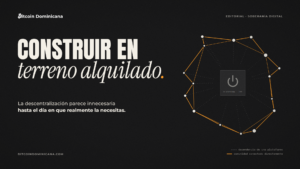
Building on rented land
When we build our entire audience on Facebook, Instagram, TikTok or X, we are building on rented land.
You can build a beautiful house. Decorate it, invite people in, fill it with memories. But the land, the neighborhood rules and the key to the gate still belong to someone else.
You have followers, but you don’t have the list. You have content, but you don’t control where it lives. You have relationships, but the only way to reach those people goes through a third party’s door.
An automated suspension, a moderation error, a new policy or an algorithm change is enough to lock you out of your own community.
Nobody has to act in bad faith. It’s enough that the infrastructure isn’t yours.
Silence doesn’t come looking for you
There is one thing this experience made very clear, and it may be the hardest to accept:
When a voice disappears from a social network, people don’t necessarily miss it. The conversation simply goes on without it.
It isn’t a lack of affection. It’s how feeds work. They are designed to fill any gap with whatever comes next. If you don’t show up, something else does. Nobody gets a notification saying «this community is gone.»
That silence doesn’t push your audience to look for you. It just leaves you out.
That’s why followers aren’t enough. We need direct relationships: ways for the community to know where to find us, even if a platform, for whatever reason, stops being available.
Not your keys, not your coins… what about your community?
Every bitcoiner knows the phrase: Not your keys, not your coins. If you don’t hold the private keys, your bitcoin isn’t really yours. It’s a promise from a third party.
We learned that lesson from exchanges that shut down, froze withdrawals or disappeared. That’s why we talk so much about self-custody.
The same logic applies to communication.
If your digital identity, your audience and your ability to reach your people depend entirely on one company, you don’t fully control that community either. You have access, for as long as they allow it.
From financial sovereignty to communication sovereignty
Bitcoin taught us to think about financial sovereignty: money nobody can print, freeze or seize with a click.
Now it’s time to think about communication sovereignty: an identity that is yours, an audience you can talk to directly, and channels that don’t depend on a single off switch.
This isn’t paranoia. It’s the same prudence we apply when we store our keys: reducing dependence on third parties wherever possible.
Nostr, explained without the jargon
This is where Nostr comes in. If you’ve never used it, here’s the short version.
Nostr is an open protocol for publishing and communicating. It isn’t a company or an app. It’s a set of common, public rules, like email, that anyone can use and anyone can build on.
Your identity is a key, not an account
On a traditional social network, your identity is an account inside a company’s database. If the company closes it, that identity disappears.
On Nostr, your identity is a pair of cryptographic keys: a public one (your «name» on the network, which you can share) and a private one (which signs everything you publish and which you must never share).
Sound familiar? It’s the same principle as a Bitcoin wallet. Whoever holds the private key holds the identity.
Many apps, one identity
Because Nostr is a protocol, there are many different apps, called clients, to use it. Some are for your phone, others for your computer; some look like X, others like Instagram.
The interesting part: you can switch apps and still be you. Your followers and your identity don’t live inside the app; they travel with you, because they’re tied to your key.
If an app shuts down or you don’t like it, you move to another one without starting from zero.
Relays: the network’s mail carriers
Your posts are sent to relays: servers that receive and distribute messages. There are many, run by different people and organizations, and you can use several at once.
If one relay stops working or decides not to carry your messages, the others keep going. There is no single point that can switch off the whole conversation.
What Nostr isn’t
Nostr isn’t perfect. It’s still young, some apps are less polished than the big networks, and the audience is smaller. Protecting your private key is your responsibility, just like with Bitcoin: if you lose it or expose it, there’s no «forgot my password.»
Nor is it a promise that everything you post will last forever or that nothing can ever be moderated: each relay and each client has its own rules. The difference is that none of them owns your identity.
This isn’t about deleting Instagram
Let’s be clear: this is not a call to abandon traditional social networks.
Big platforms are still very useful for discovery and reach. That’s where people who don’t know Bitcoin yet are, where many find their first meetup, where what we do gets shared.
The idea isn’t «delete Instagram.» The idea is diversify your digital presence.
Use centralized networks so people can find you. But also build your own open channels to keep a direct connection with your community. So that the day one door closes, others are still open.
What we’re doing at Bitcoin Dominicana
Bitcoin Dominicana will stay on traditional platforms. But this experience is pushing us to strengthen our own infrastructure.
We want:
- finding us not to depend only on Instagram;
- our events not to depend only on Facebook;
- our conversations not to depend only on X;
- our community to have several ways to stay connected.
And we’ve already started taking concrete steps. As part of this process, Bitcoin Dominicana began strengthening direct channels with its community, while we keep exploring open protocols. This is what that strategy looks like today:
- BitcoinDominicana.com as our home base. The place where our articles, guides, frequently asked questions about Bitcoin and event calendar will always live. Our own domain, independent of any network.
- Signal for direct contact. We opened a Bitcoin Dominicana space on Signal, a private messaging app with end-to-end encryption, to talk with the community without depending on an algorithm. Join the Bitcoin Dominicana group on Signal.
- Nostr. We’re preparing our presence on the protocol. When it’s ready, we’ll announce it here, with a guide so you can follow us even if you’ve never used it.
- Direct lists. We want to build a newsletter or contact list, with your consent, to tell you about events and content without going through any algorithm.
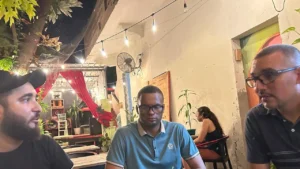
- In-person events. Meetups are still the most resilient network there is: people who know each other, shake hands and know how to find each other again.
- Community channels and other open tools we add over time, always with the same idea: more roads, less dependence on any single one.
It’s worth not confusing them: Signal and Nostr serve different purposes. Signal is a private messaging service, run by a non-profit foundation, that protects the content of conversations with end-to-end encryption; it works for us as a direct channel, but it still runs on a single provider’s infrastructure. Nostr, on the other hand, is an open protocol based on keys and relays, where identity doesn’t depend on any company or server. One doesn’t replace the other: they complement each other.
Our website, Signal and meetups are already up and running; Nostr and direct lists we’ll build calmly, together with the community. Traditional networks will still be there so new people can discover us. We’ll keep you posted.
A community with more than one road
The point was never to tell you we lost access to some accounts. That happens. It will probably happen to someone else, and not only to bitcoiners.
The point is what we learned: the internet works better when our identity, our audience and our ability to communicate don’t depend entirely on a single company.
It’s the same philosophy that brought us to Bitcoin. And at Bitcoin Dominicana we want to apply it to our own community too.
Decentralization seems unnecessary until the day you need it. Better to have it ready beforehand.
Bookmark bitcoindominicana.com. It’s our home, whatever happens on social media. And if you’re visiting the Dominican Republic and want to talk about digital sovereignty, Nostr or self-custody in person, come to one of our meetups: the calendar will always be here.